How to play
Tile Shift
Slide the numbered tiles into order, 1 to 15 — a new puzzle every two hours.
By Alex Lanka teamPublished
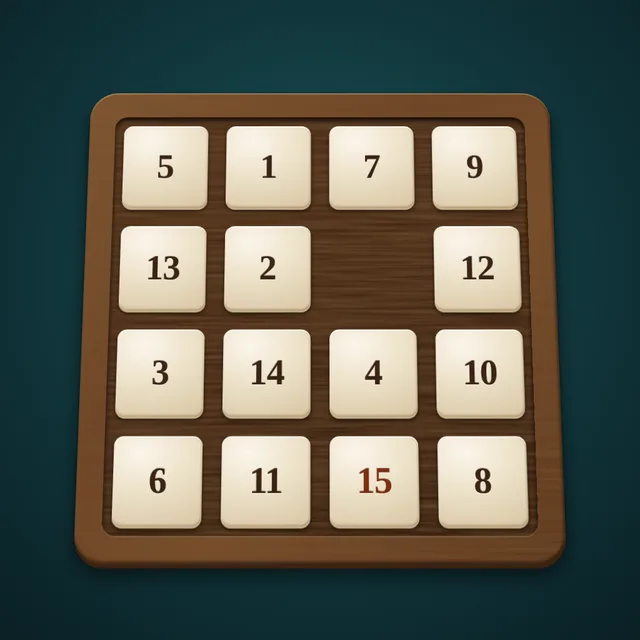
Tile Shift is a sliding-tiles puzzle in a wooden tray. The tray is four squares wide and four deep. Fifteen ivory tiles, numbered 1 to 15, fill all but one of the squares, and the tiles start out of order. The one empty square is what lets anything move: a tile beside it can slide into it, which leaves a new gap where the tile used to be. The puzzle is finished when the tiles read 1 to 15 in order, row by row from the top left, with the empty square in the bottom right corner.
That is the whole rule, and it is enough to make a real puzzle. Tiles never jump over each other or lift out of the tray, so getting one tile home always means moving others out of its way — and then back again. The trick is to fix a few tiles in their places and never disturb them, so the part of the tray you still have to think about keeps getting smaller. Once you know the method, any tray can be solved; doing it in few moves is what takes practice.
Our server makes every puzzle by sliding the tiles of a finished tray at random, so each one can always be solved — half of all random arrangements of fifteen tiles cannot, and you will never be given one of those. It then works out the true fewest moves with a solver and shows that number to you as the Perfect mark. Every puzzle uses the same 4 × 4 tray: easy ones can be done in about 16 to 24 moves, medium ones in 30 to 38, and hard ones in 44 to 52.
How to start a game
- 1Open Tile Shift on Alex Play Zone and press Start Puzzle; the clock starts when the tray appears.
- 2Tap (or click) a tile next to the empty square and it slides in. Tap a tile further along the same row or column and the whole line between it and the gap slides over at once.
- 3You can also drag tiles with your finger or the mouse: the line of tiles follows you, and if you let go past about a third of a square, the slide finishes; let go earlier and the tiles settle back.
- 4On a computer the arrow keys slide the tile next to the gap in that direction.
- 5Watch the counter under the tray: your moves, the Perfect mark (“Perfect in 34”), and how many tiles are already in place.
- 6Undo slides one tile back (Backspace or Z works too). Restart puts the tray back as it started.
- 7Hint slides one tile for you along a short way to the finish.
The rules of Tile Shift
The rules
- Only a tile beside the empty square can move, and it moves into that square.
- Pushing a line of tiles at once is allowed; each tile that moves one square counts as one move.
- The puzzle is solved when the tiles read 1 to 15 in order, row by row, with the gap in the bottom right corner.
- Solving in no more moves than the Perfect mark, without a hint, is a Perfect solve.
A new puzzle every two hours
- One new puzzle is made every two hours, and it is the same for every player.
- You get one go at each puzzle. Leave and come back whenever you like: your grid is kept and the clock only runs while the puzzle is open.
- When the next puzzle arrives, an unfinished one is closed and shows as abandoned in your Battle Log.
Rewards
- The faster you finish, the more XP and coins you earn.
- Tile Shift pays double our other puzzles: up to 56 for an easy puzzle, 88 for a medium and 120 for a hard one — and a quarter more for a Perfect solve, up to 150.
- A solve also counts for double the rank of another puzzle of the same difficulty.
- Each hint takes 10% off the reward.
How to play well
Solve it row by row
Do not try to fix everything at once. Get the top row — 1, 2, 3 and 4 — into place first, then leave it alone for the rest of the puzzle. Next do the left column below it (5, 9 and 13). What is left is a three-by-three corner, which is a much smaller puzzle, and after the next row and column only a two-by-two square remains, which nearly solves itself.
The last two tiles of a row go in together
The one move that confuses everybody is finishing a row. If you put 3 in its place and then try to bring 4 beside it, you will find there is no room. Instead, put 4 where 3 belongs first, then bring 3 just below it, and swing the gap round so both slide into place in two moves. The same trick finishes a column: 13 first, then 9 beside it, then both together.
Move the gap, not the tile
It helps to think about where the empty square is, not about the tile you want to move. To move a tile one square left, the gap has to travel round to its left side first. Bring the gap there by the short way, keeping well away from the tiles you have already placed.
Use pushes to save time
Tapping a tile at the far end of a row slides the whole line in one tap. It is still several moves, but it is one quick action, which keeps your clock down on longer puzzles.
Chase the Perfect mark later
The row-by-row method always works but rarely matches the fewest moves. Once you can finish every puzzle, try to spot shortcuts: tiles that can travel home together, or a row you can build while the next one is already half there.
Remember: Finish the top row first, then the left column, and leave them alone — what is left is a smaller puzzle that is much easier to see through.
Common mistakes
- Placing the last tile of a row on its own, then finding the row has to be broken up again.
- Moving tiles that are already home to make room for others, without a plan to put them back.
- Sending the gap the long way round, past tiles you have already placed.
- Undoing and redoing the same slides instead of stopping to look at where the gap needs to go.
- Ignoring the Perfect mark — it shows how close to the best way your solve was.
Questions and answers
- Can every puzzle really be solved?
- Yes. Every tray is made by sliding the tiles of a finished one, so it can always be slid back. The server also solves it before anyone plays, and that solve sets the Perfect mark.
- Can I get stuck?
- No. A sliding-tiles tray can never jam: from any position there is always a way to the finish. Undo takes back one move and Restart starts again; both are free, and your clock keeps running. A hint slides one tile for you.
- How are easy, medium and hard different?
- Every puzzle uses the same 4 × 4 tray with tiles 1 to 15. What changes is how mixed up it is: easy puzzles can be done in about 16 to 24 moves, medium in 30 to 38, and hard in 44 to 52.
- What counts as a move?
- Each tile that slides one square. Pushing a line of three tiles with one tap counts as three moves.
- Can I play on my phone?
- Yes. Tap a tile to slide it, or drag it with your finger — the tiles follow you and settle into place when you let go.
Ready to play Tile Shift?
It is free and runs in your browser — no download, no sign-up needed.
Play Tile Shift on Alex Play Zone →